
.png)
Pairing two standards for Large-Scale IoT Management
Operators of long lived, large scale IoT deployments have already experienced the importance of interoperability. It is a fundamental insurance policy against supply chain constraints, lifecycle risk, operational cost inflation, and vendor lock in. From utilities, through smart cities, all the way to the industrial operators, the prospect of relying on fragmented and non-standardized management approaches introduces unnecessary complexity and ultimately limits scalability and long-term control.
The Wi‑SUN ecosystem is an example of interoperability done right at the network layer: Wi‑SUN FAN provides an IPv6-based, secure mesh foundation for large-scale field deployments.
But many deployments are now hitting a predictable next constraint: network interoperability does not automatically produce operational interoperability.
The gap is architectural, not ideological
Wi‑SUN FAN is deliberately layered. The FAN protocol stack defines how packets move (PHY/MAC and mesh services), how routing works (IPv6 with 6LoWPAN adaptation and RPL), and how devices authenticate and secure access (e.g., 802.1X/EAP‑TLS and certificate-based identity).
At the same time, Wi‑SUN FAN explicitly marks the application layer as outside of scope.
That design choice is reasonable: it enables innovation above the network. However, it also means that in real-world deployments, operators often face a management reality where different vendors expose different data models, onboarding processes, update mechanisms, and diagnostic workflows, despite sharing a seemingly interoperable network.
Why the problem is intensifying now
Two trends amplify this challenge.
First, hybrid connectivity is becoming normal. It is increasingly common for ecosystems to deploy combinations of mesh and cellular (public and/or private), depending on topology, cost predictability, and application requirements. This is not limited to metering: city lighting controllers, distributed sensors, and industrial edge nodes may share one operations model across multiple bearers.
Second, security requirements are rising and becoming time-bound. In the EU, the Cyber Resilience Act sets a staged compliance timeline: reporting obligations begin in 2026, while the main obligations apply from 2027. In parallel, post‑quantum cryptography is moving from roadmaps into formal baselines: NIST approved FIPS 203/204/205 as post‑quantum cryptography standards already in 2024.
In such an environment, fragmented management is more than an inconvenience, instead, it becomes a security and auditability risk.
LwM2M as a standardized management plane over multiple networks
OMA Lightweight M2M (LwM2M) is a standardized protocol for device management across IoT environments. It enables a wide range of functions—including device monitoring, configuration, control, and firmware/software updates—through a single, unified framework. Designed specifically for constrained environments, LwM2M typically operates over CoAP, making it well-suited for low-power devices and lossy network conditions.
These characteristics make LwM2M particularly well-suited for Wi-SUN deployments, as well as for other large-scale IoT fleets operating across heterogeneous network bearers.
Standardized data models through Objects and Resources
LwM2M defines a structured object model, and OMA maintains a public object registry and registration process (OMNA - Open Mobile Naming Authority). This is a practical mechanism for industry-wide semantic alignment, so crucial when multiple vendors must operate in one fleet.
Critically, “standardized objects” are not limited to a single category: OMNA defines distinct ObjectID classes, including OMA objects, third‑party standards objects, vendor objects, and even “Company Reserved” ranges explicitly intended for private objects not published in the public registry.
This matters in practice: ecosystems can align on a minimal common profile (public objects + shared vertical objects), while still allowing vendors or operators to extend where needed, either by publishing new vertical objects through the OMNA process, or by keeping certain objects private when business or regulatory constraints require it.
A bridge that already exists: uCIFI LPWAN objects inside the OMNA registry
There is already a concrete example of cross‑ecosystem alignment between network technologies and the OMA management/data-model layer: the uCIFI Alliance, now integrated into OMA’s Smart City work program, has published and maintains a set of LwM2M objects inside the OMNA registry.
Most relevant for Wi‑SUN-like deployments are uCIFI’s LPWAN-focused objects, which effectively act as a semantic “adapter” layer between a network stack (mesh/cellular/LPWAN) and an interoperable management/NMS interface:
- LPWAN Communication (Object 3412): includes “type of network” (examples explicitly include LoRaWAN, NB‑IoT, wireless mesh, power line), IP addressing, LPWAN address fields, and multicast group address/key, plus radio metrics and cellular identifiers where relevant.
- LPWAN Mesh Connectivity (Object 3447): explicitly targets monitoring/management parameters for 802.15.4-based LPWAN devices.
- LPWAN Mesh Statistics (Object 3448): explicitly collects performance statistics tailored to 802.15.4 mesh networks, spanning MAC- and network-layer stats as applicable to the specific 802.15.4 technology.
This is important because it shows the “Wi‑SUN network layer + LwM2M management layer” concept is not hypothetical: key building blocks are already standardized and published.
Operational primitives for diagnostics and lifecycle (NMS-grade)
The standardized “Connectivity Monitoring” object carries connectivity signals such as bearer type, radio signal strength, link quality, and IP addressing. For operations teams thinking in NMS (Network Management System) terms, this is the missing piece: consistent, vendor-neutral telemetry and diagnostics primitives that can feed alarms, dashboards, and triage workflows across device types and bearers. These signals are also exactly what field operations teams need for consistent offline detection and root-cause analysis.
For firmware updates, LwM2M standardizes the device-facing firmware contract (Firmware Update object), including push/pull models and a Package URI mechanism, and explicitly expects constrained transfer behaviors (e.g., block-wise transfer when using CoAP-based transports).
What’s important here, this kind of standardization does not eliminate vendor differentiation, but it does provide a common device lifecycle contract on which scalable platforms can build.
Security: certificate lifecycle for constrained devices
The LwM2M Transport specification includes TLS/DTLS-based and OSCORE-based security, and it optionally supports TLS 1.3 / DTLS 1.3, to prevent eavesdropping, tampering, and message forgery.
It also defines “Certificate mode with EST,” enabling devices to generate key pairs locally (so private keys never leave the device), and then obtain certificates via EST over CoAP.
In such flows, EST decouples PKI from the LwM2M provider, giving organizations full control over their certificate infrastructure and trust model. This makes it easier to use existing enterprise PKI processes instead of relying on a provider-managed setup.
In addition to transport-layer security, CoAP can also be protected end-to-end at the application layer using OSCORE (Object Security for Constrained RESTful Environments), which is particularly relevant when proxy/gateway patterns exist and when end-to-end protection is desired beyond hop-by-hop DTLS.
The net effect for large-scale IoT operators is more credible certificate lifecycle governance, cleaner separation between “device management plane” and “PKI ownership,” and a clearer path to crypto agility under emerging regulatory and procurement pressure.
How to combine Wi‑SUN and LwM2M in practice
A practical integration architecture follows the same layering philosophy as the standards:
-
Wi‑SUN FAN provides the IPv6 mesh transport from endpoints to border routers, relying on its proven routing and security fundamentals.
-
LwM2M runs above IP (with non-IP transports also being supported in specs). Endpoints implement an LwM2M client (directly or via a gateway pattern), expose standardized objects for operations, and connect to an LwM2M server for lifecycle actions.
For hybrid deployments, cellular endpoints can be managed using the same LwM2M contract, enabling a single operational model across bearers.
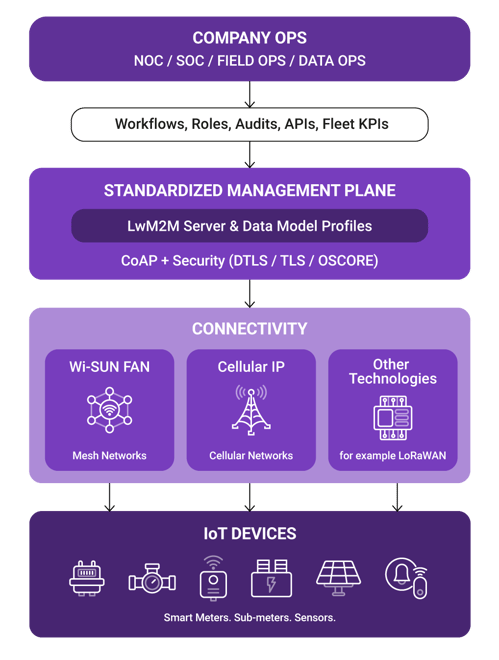 Graph 1. Architecture proposition: Wi-SUN FAN & OMA LwM2M as complementary standards.
The ecosystem path forward: profile + demo + interop validation
A realistic, alliance-friendly approach is incremental:
1. Define a minimal “Wi‑SUN & LwM2M Management Profile” (what every device should support), starting with existing OMNA objects and uCIFI LPWAN objects where they already align with Wi‑SUN mesh realities.
2. Stand up a multi-vendor demo environment that the ecosystem can showcase at industry events.
3. Validate interoperability through neutral test events. OMA explicitly runs multi‑vendor validation activities around LwM2M interoperability.
This approach mirrors what made Wi‑SUN successful at the network layer: shared requirements, conformance culture, and practical interoperability proof—extended into the management plane.
Closing thought
Wi‑SUN FAN and LwM2M are not competing standards. Wi‑SUN brings interoperable, secure IPv6 mesh networking; LwM2M brings interoperable, secure device lifecycle management and—through work like uCIFI’s LPWAN objects—already has a published path for standardizing key management-plane signals across LPWAN and mesh technologies.
For any large-scale IoT operator facing multi-vendor fleets, hybrid connectivity, and rising security expectations, combining both layers is one of the most direct ways to reduce operational fragmentation without eliminating innovation.
Table 1. Pain points to standard features to exemplary client and server capabilities.
|
Large-scale IoT pain point (operations)
|
LwM2M objects / standard features / Wi-SUN reality (examples)
|
LwM2M client and server capability mapping (examples) |
| Offline detection & faster triage |
Connectivity Monitoring (Object 4) is explicitly intended to “enable monitoring of parameters related to network connectivity,” including signals like link quality and radio signal strength. uCIFI LPWAN Communication (3412) adds LPWAN- and multicast-oriented signals (including multicast group address/key) and a “communication failure” indicator. | LwM2M server provides fleet monitoring at scale (including segmentation via device grouping) and operational workflows for managing device connectivity states. Operational note: pair standardized connectivity objects with platform-side alert thresholds and “device silent” timers to reduce truck rolls and time-to-triage. |
| Mass onboarding and provisioning at scale |
LwM2M bootstrap/registration patterns standardize onboarding flows; Wi‑SUN provides IP reachability under an application-agnostic upper layer. For certificate provisioning in constrained environments, EST‑coaps standardizes EST over secure CoAP. | LwM2M server includes Bootstrap Server, bulk device registration, and multi‑tenancy/user management; supports secure channels DTLS/TLS and certificate-based authentication. |
| Safe firmware updates at fleet scale |
LwM2M Firmware Update object standardizes update lifecycle (including Package URI and constrained transfer patterns). |
LwM2M server supports group FOTA operations and campaign management patterns (including staged rollouts, monitoring success/failure, and selective retries). Limiter/throttling concepts (as used in practice) are a direct response to large-fleet realities: controlling concurrency to reduce network overload and avoid synchronized failure modes. |
| Root-cause analysis & remote diagnostics |
Connectivity Monitoring (Object 4) standardizes access to bearer + radio-level signals (including explicit “Network Bearer” categories and radio signal strength), helping unify diagnostics across transports. uCIFI LPWAN Mesh Statistics (3448) adds 802.15.4 mesh-oriented MAC and network stats that can be exported to an NMS for deeper analysis. | LwM2M client enables consistent on-device exposure of standardized objects. LwM2M server provides operational tooling plus integration points (APIs/event streams) to support alerting and to connect device signals to existing NMS/OSS workflows (e.g., “alarm when link quality drops,” “alarm when device silent,” “campaign alerting on error spikes”). |
| Security and key/certificate lifecycle management |
DTLS 1.3 provides standardized datagram security properties. EST‑coaps standardizes certificate provisioning over secure CoAP, targeting constrained devices. OSCORE adds application-layer, end-to-end protection for CoAP messages (useful with proxies/gateways and for “true E2E” security models). | LwM2M server offers DTLS/TLS, certificate-based authentication, and EST integration; includes DTLS session resumption/Connection ID. Additionally, OSCORE is supported for additional application-layer security. |
| Multi‑bearer reality: mesh + cellular |
Wi‑SUN FAN standardizes the IP mesh below an application layer that remains out of scope, enabling multiple application/management approaches. Connectivity Monitoring (Object 4) explicitly enumerates bearers, including IEEE 802.15.4 and NB‑IoT. uCIFI LPWAN Communication (3412) explicitly spans LoRaWAN/NB‑IoT/wireless mesh/power line and includes multicast grouping. | LwM2M server supports flexible deployment models (SaaS / private / on‑prem) suitable for different regulatory and operational contexts. LwM2M client supports LwM2M on constrained endpoints, supporting a “single management contract” across mixed bearers. |
Resources:
- https://www.openmobilealliance.org/solutions/smart_cities/joins
- https://www.openmobilealliance.org/specifications/registries/objects/
- https://www.openmobilealliance.org/media/articles/2024-12-9-press-release-ucifi-joins-oma
- https://www.openmobilealliance.org/release/LightweightM2M/V1_0-20170208-A/OMA-TS-LightweightM2M-V1_0-20170208-A.pdf
- https://wi-sun.org/wi-sun-technical-papers/
- https://wi-sun.org/wp-content/uploads/Wi-SUN-Overview-NAInterop-August-2025-r2.pdf
- https://github.com/OpenMobileAlliance-Archive/VOID-openmobilealliance.github.io/blob/prod/testfest.html
- https://wi-sun.org/wp-content/uploads/Wi-SUN-FAN-Tech-Overview-r0.pdf
- https://wi-sun.org/blog/what-to-look-for-in-a-wireless-mesh-network-for-ami-2-0-smart-grids/
- https://wi-sun.org/blog/powering-the-future-why-utilities-are-upgrading-to-ami-2-0-with-wi-sun-fan/
- https://wi-sun.org/blog/wi-sun-fan-has-the-interoperability-and-versatility-to-make-a-major-impact-in-latin-america/
- https://iotdevzone.avsystem.com/docs/Coiote_IoT_DM/introduction/